
Guns or Butter
The Case for a Four-Power Global Military Union

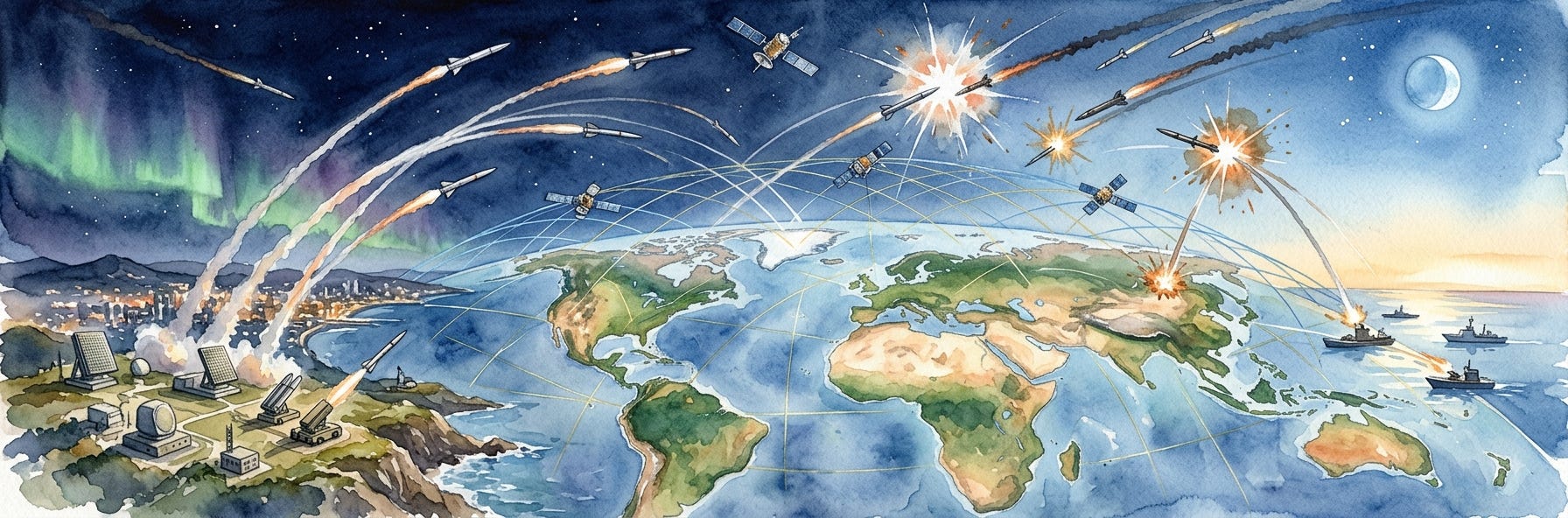
Trillions of dollars are currently locked in a global gridlock of mutual fear, but a radical consolidation of military power among the world’s four dominant entities could break the security dilemma and unlock an unprecedented peace dividend.
Every day, public money that could fund cancer research, rebuild failing schools, or modernize crumbling infrastructure is instead funneled into weapons designed to neutralize a nation across the sea. Global military spending reached $2.9 trillion in 2025, driven by the security dilemma: every nation builds weapons to feel safe, and in doing so makes its neighbors feel less safe. Four powers can end that cycle among themselves and redirect the savings toward the world they actually want to live in.
The United States, NATO’s remaining members, China, and Russia together account for roughly three-quarters of global military spending. Merge their forces at the platoon level, and you remove the thing that makes betrayal possible: an independent chain of command. Every tactical unit becomes a working mix of personnel from all four regions, bilingual by requirement, reporting through a structure that answers to all four capitals at once. The union is defensive by charter, the same as NATO, which two of its four pillars already are today. Responding to a confirmed attack requires a supermajority vote. Anything short of a confirmed attack, including preemptive action, the justification that opened the door to Iraq and has been invoked again for Iran, requires unanimous consent from all four, which means no single member, or even three of four, can dress up a first strike as self-defense and act on it. An order that bypasses either threshold fails on the ground, because the soldiers required to carry it out did not agree to it. Defense budgets fall by half. The freed capital, over a trillion dollars a year, funds universal healthcare, global education infrastructure, and the climate engineering the world has been too broke and too armed to attempt.
The decisive incentive is not the peace dividend itself, though that matters. It is the removal of the primary security threat each of the four faces. For the United States, China and Russia represent the only peer or near-peer military dangers capable of imposing catastrophic costs on the American homeland or its core interests. For China, the United States and its alliance system constitute the central external constraint on its regional and global ambitions. For Russia, NATO remains the organizing threat. Mutual integration at the force level, combined with binding rules that make unilateral attack structurally impossible, converts those threats from permanent conditions into solved problems. Each power gives up the freedom to act alone against the others; in return it gains the near-certainty that the others cannot act alone against it. The sovereignty cost is real, but it is paid to eliminate the only adversaries that currently justify the bulk of each nation’s defense effort. Relative influence and freedom of action outside the union remain contestable through economics, technology, and diplomacy. What disappears is the capacity of any one of the four to settle those contests by force of arms against the others.
Taiwan and Ukraine become non-issues the day China and Russia join, because the forces that would invade them no longer exist as independent instruments, and the unanimous-consent threshold closes the preemptive-action loophole that a determined member might otherwise reach for. What replaces unilateral national defense for allies outside the union is a treaty structure: South Korea, Japan, and other partners fall under the compact’s shared shield, defended by joint capability rather than by any single member’s arsenal. When North Korea launches at a treaty ally, the joint early warning system, built and staffed by all four powers, confirms the launch and interception is automatic. No vote, no delay. A retaliatory campaign against the aggressor runs through the supermajority vote, the same threshold that governs every other defensive use of force, which means the union protects its allies from destruction immediately and decides on punishment deliberately.
The nuclear question is where the union does its most important work. Confirmation comes from cross-verified data across independently operated sensor networks, not a single fused feed, so a false positive from one system gets caught by the other three before it reaches a human. Interception fires automatically on confirmation, no vote required. Retaliation does not. A confirmed attack goes to four on-duty watch commanders, one from each member, staffing that post around the clock in shifts, and their sign-off goes to central command for a second round of four votes before a retaliatory launch executes. Two layers, eight people, minutes rather than hours, and no single nationality present at either layer without the other three watching in real time. That is faster than any deliberative body in existence today and slower than a true automatic trigger by design, because the seconds it costs to get eight people to agree are exactly the seconds that catch the error a single command structure would have missed.
Membership is permanent. A member surrenders its national arsenal once, in exchange for security and a lower bill, and that trade does not come with a return policy. Disputes get resolved by vote, not by exit. A member on the losing side of a vote stays a member and lives with the outcome, the way a minority party in any functioning democracy lives with a lost bill. This is what makes the union durable: there is no scenario where a member reconstitutes an independent arsenal, because doing so would require rebuilding a shadow force under the watch of the very personnel who used to serve alongside them. It’s a marriage without the option of divorce.
Funding follows the same logic. A member that falls behind on contributions does not get a stronger vote or a weaker one; voting power stays equal regardless of who pays, and the merged force absorbs the shortfall as a shared capability loss rather than handing leverage back to any single capital. Russia’s territory, China’s industrial base, NATO’s combined industrial and technological base, and America’s worldwide network all count as contributions in their own right, not just line items on a budget.
Smaller nations lose little they currently hold. The UN Security Council already concentrates real power in five permanent members, four of whom are the powers this union proposes to merge, while the ten rotating seats turn over every two years and carry no veto and no independent leverage of consequence. What the council has always lacked is teeth: no command, no control, and no capability behind its resolutions beyond whatever individual members choose to contribute. This union does not dilute that arrangement; it operationalizes it, giving the same capitals that already hold the world’s decisive votes the merged force to back those votes with something real.
This union does not resolve the differences that have often driven war in the past: the ideological clash between capitalism and communism, the religious and nationalist conviction that God or history favors one side, the older imperial appetite for another nation’s land and resources. Four merged militaries do not make Beijing and Washington agree on how a society should be governed, and they do not make Moscow’s view of its borders match Brussels’. What changes is not the disagreement; it is what is available to settle it. The argument continues. The capacity to end it with mass killing does not.
That is the honest cost and the honest promise of this proposal together. The four powers gain new tools of influence through trade and technology that used to run through weapons instead, and the world pays a smaller price for that than it pays today, where entire engineering careers, entire industrial bases, are built around designing things meant to kill each other’s citizens. The union does not promise a world without danger, and it does not promise a world without disagreement. It promises four fewer places that danger can start, and a trillion dollars a year to spend on everything else.